Celestial Orrery
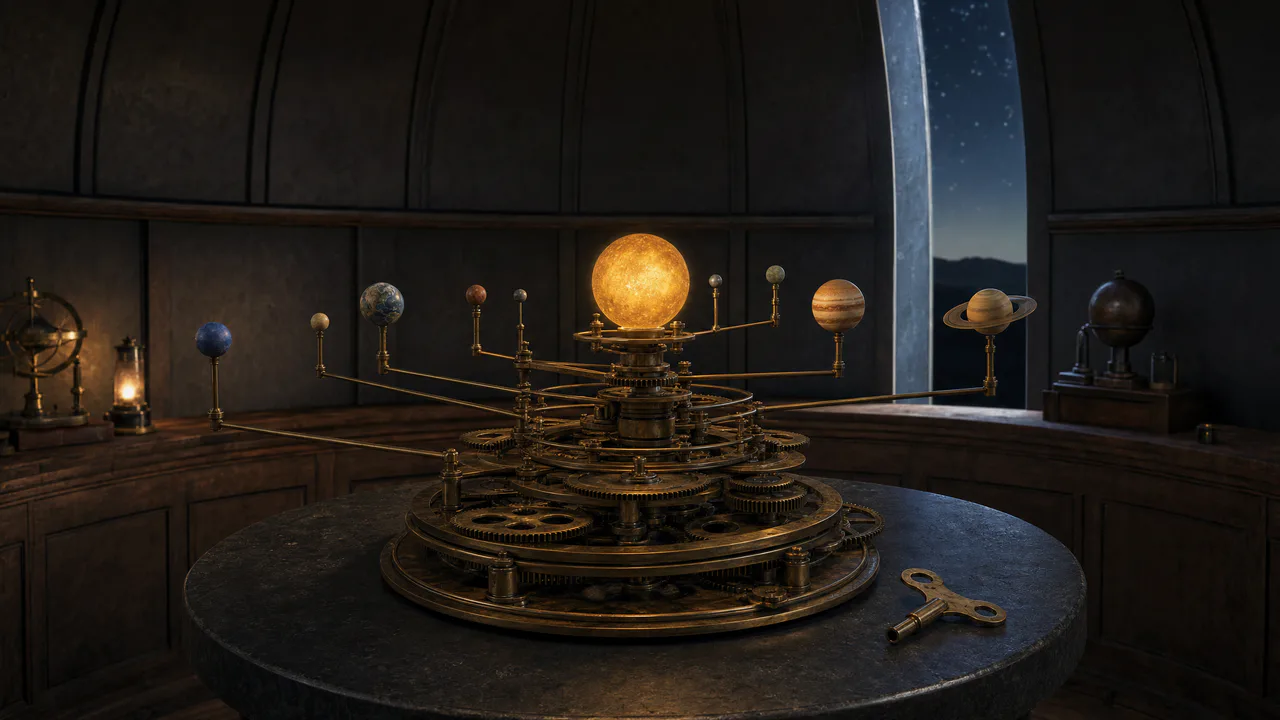
A brass orrery in a dark observatory: nine planets on arms around a glowing sun, turning at their true speeds compared with each other.
Slow orbits
Brass arms carry the planets slowly round the sun. The inner planets go round in under a minute; the outer ones barely seem to move. Nothing flashes. Sound plays only if you start with it.
What you can do here
- Point at a planet
- Move over a planet and its arm catches the light, and the line under the picture tells you how long its year is, both in the sky and here on the brass.
- Choose the pace
- Pace sets how long the Earth takes to go round: four minutes on Slow, where it starts, one minute or twenty seconds. Every other planet keeps its true speed compared with the Earth, so on Steady, Mercury laps the sun in under fifteen seconds while Saturn takes half an hour and Pluto most of an afternoon.
- Wind the key
- Tap the brass key on the table, press Wind the key, or press W. You hear it wound, it catches the light, and the planets run a little faster for a few seconds while the spring is tight.
- Watch the phases
- The sun is the only light on the planets, as in a real orrery with a lamp in the middle. A planet on the far side faces you with its lit half; one swinging round in front shows you its dark side, the way Venus and Mercury show phases through a telescope.
Use it as your wallpaper
Press F for fullscreen and M to turn the sound off and on; the volume and your sound choice carry over to every wallpaper. The sound keeps playing if you switch to another tab.
Live link
https://whitescreen.tv/interactive-wallpapers/celestial-orrery/#wallpaper- On a computer desktop
- Some wallpaper apps can show a web page behind your desktop icons. Give one the live link above and the scene runs there on its own: no page around it, no ads and no sound.
- On a TV or a spare screen
- Open this page and press F, or use Fullscreen. While it’s in fullscreen we ask the browser to keep the screen from going to sleep.
- On a phone or tablet
- Save image downloads exactly what’s on the screen as a picture. Set it as your wallpaper from your photos; the phone will crop the sides.
A live wallpaper keeps a page running all day. Through the live link the scene draws at most 30 frames a second and stops while the screen is covered, but on a laptop it still costs some battery.
What is true here, and what isn’t
The speeds are true: each planet takes the same number of Earth years to go round as the real one does, from Mercury’s 88 days to Pluto’s 248 years. So is the order of the arms, Mercury’s shortest and Pluto’s longest. The distances and sizes are not, as on almost every orrery ever made. At true scale, with the Earth an inch from this sun, Neptune would sit thirty inches out and every planet would be a speck. The orrery in the picture also keeps Pluto, as many older ones do.
Why it is called an orrery
The first one was built in London around 1704 by the clockmakers George Graham and Thomas Tompion. John Rowley made a copy for Charles Boyle, the 4th Earl of Orrery, and every model of the solar system since has carried his name. They were teaching instruments: turn the handle, and a room could watch a year go by in a minute.
About the sounds
Three recordings: the soft run of the orrery’s gears, the winding key, and the air of a quiet room. The gears get a little louder as the pace goes up.
If you’d rather just watch
Picture and sounds generated from our prompts. Motion, controls and mix by WhiteScreen.tv.
