Autumn Covered Bridge
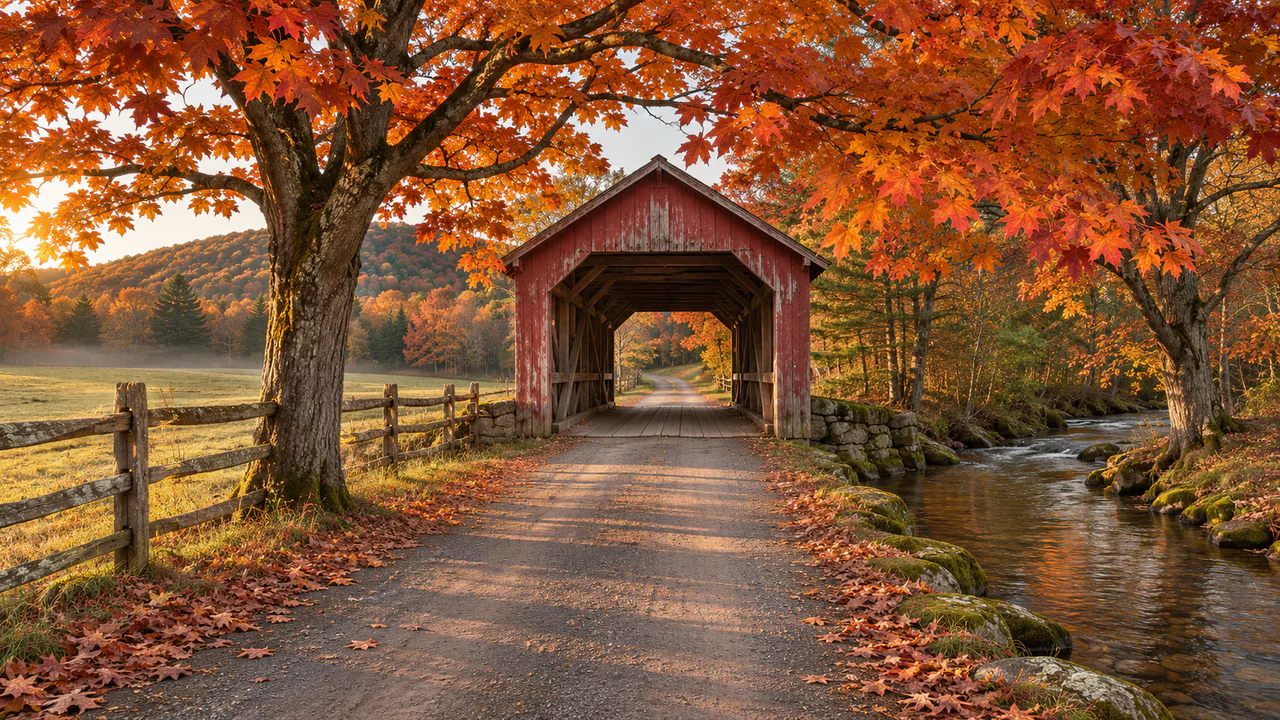
A country lane, two old maples at peak color, a red covered bridge and a stream beside the road, all in late-afternoon sun. The wind comes through in gusts, and leaves come down with it.
Leaves in the wind
The trees sway, leaves drift down and the stream runs. Nothing flashes. Sound plays only if you start with it.
What you can do here
- Set the wind
- Wind runs from a nearly still afternoon to a fresh breeze. Gusts come more often and push harder, and more leaves let go.
- Tap the trees
- Tap anywhere in the leaves and a gust comes through from the left. You can watch it arrive: the leaves shiver first, the branches lean a moment later and swing back, and a few leaves come loose near where you tapped. It can’t come again for six seconds.
- Watch where they land
- Leaves that come down close to you are big and fall fast; the ones out by the bridge are small and slow, because they’re farther away. They lie where they land for half a minute or so. One that lands in the stream gets carried off.
- Tap the stream
- A ring spreads from your finger and drifts away with the current.
Use it as your wallpaper
Press F for fullscreen and M to turn the sound off and on; the volume and your sound choice carry over to every wallpaper. The sound keeps playing if you switch to another tab.
Live link
https://whitescreen.tv/interactive-wallpapers/autumn-covered-bridge/#wallpaper- On a computer desktop
- Some wallpaper apps can show a web page behind your desktop icons. Give one the live link above and the scene runs there on its own: no page around it, no ads and no sound.
- On a TV or a spare screen
- Open this page and press F, or use Fullscreen. While it’s in fullscreen we ask the browser to keep the screen from going to sleep.
- On a phone or tablet
- Save image downloads exactly what’s on the screen as a picture. Set it as your wallpaper from your photos; the phone will crop the sides.
A live wallpaper keeps a page running all day. Through the live link the scene draws at most 30 frames a second and stops while the screen is covered, but on a laptop it still costs some battery.
How a maple leaf falls
A falling leaf hardly ever drops straight. It glides one way, tilts up and nearly stops, then slides back the other way, coming down fastest through the middle of each swing. Every so often one flips over and tumbles instead. Either way it falls at about three feet a second, roughly a walking pace, which is why even a light breeze can carry it well away from its tree.
Why the bridge has a roof
The roof is there for the bridge, not the traveler. The wooden trusses that carry the road rot quickly when they stay wet; an open timber bridge might last ten or twenty years, a covered one many decades. Hundreds still stand in the United States, a lot of them in Pennsylvania, Ohio, Indiana and New England.
About the sounds
Two recordings and one quiet layer: leaves and the stream along the lane, a gust through the canopy when you tap, and open country air. The gust waits six seconds between plays. The lane and the air get louder as you raise the wind.
If you’d rather just watch
Picture and sounds generated from our prompts. Motion, controls and mix by WhiteScreen.tv.
