Starship Bridge
A quiet bridge, a wide window, and more stars than you can count. Push the ship toward the speed of light and see what really happens to the sky.
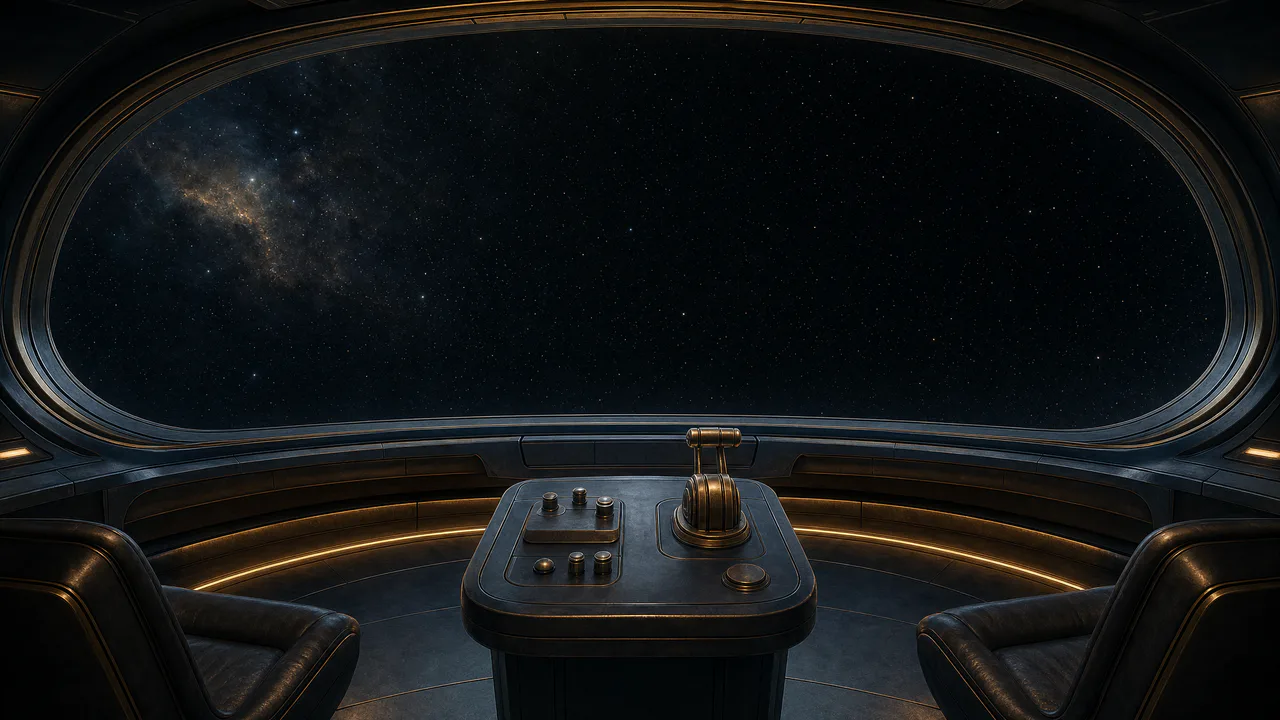
Slow stars
The ship rolls slowly, about one turn an hour, so the stars turn around the window. Raising Speed gathers them toward the middle over several seconds. They never streak, and nothing flashes. Sound plays only if you start with it.
What you can do here
- Push toward the speed of light
- Speed takes the ship from rest to nine-tenths of the speed of light, easing up over a quarter of a minute as if under steady thrust. Watch the stars crowd toward the middle of the window, turn bluer and brighter there, and fade and redden at the edges. At a steady speed they hold still again.
- Let the ship roll
- With Slow roll on, the ship turns on its long axis about once an hour, and the stars wheel slowly around the middle of the window. Turn it off and the roll eases to a stop.
- Lean toward the glass
- Move the pointer toward a side of the window and the stars shift a little against the frame, the way they would if you leaned that way.
- Touch the relay
- Tap the brass lever on the pedestal, or press Touch the relay, for the relay’s soft acknowledgment and a warm glint on the brass.
Use it as your wallpaper
Press F for fullscreen and M to turn the sound off and on; the volume and your sound choice carry over to every wallpaper. The sound keeps playing if you switch to another tab.
Live link
https://whitescreen.tv/interactive-wallpapers/starship-bridge/#wallpaper- On a computer desktop
- Some wallpaper apps can show a web page behind your desktop icons. Give one the live link above and the scene runs there on its own: no page around it, no ads and no sound.
- On a TV or a spare screen
- Open this page and press F, or use Fullscreen. While it’s in fullscreen we ask the browser to keep the screen from going to sleep.
- On a phone or tablet
- Save image downloads exactly what’s on the screen as a picture. Set it as your wallpaper from your photos; the phone will crop the sides.
A live wallpaper keeps a page running all day. Through the live link the scene draws at most 30 frames a second and stops while the screen is covered, but on a laptop it still costs some battery.
What the sky really does at near light speed
Films show stars stretching into streaks. Physics says otherwise. Moving fast, you run into starlight from ahead, so light from every direction seems to come from farther forward: this is aberration. At half the speed of light a star that was straight off to the side appears only 60 degrees off the bow; at nine-tenths, 26 degrees. The light from ahead is also Doppler shifted toward the blue, its frequency raised by a factor of about 1.7 at half light speed and 4.4 at nine-tenths, and it arrives brighter, while the light from behind shifts red and dims. The page works this out for every point of the window.
No starbow
Science fiction once promised a rainbow ring of shifted starlight, the starbow, ahead of a fast ship. When physicists checked in 1979, they found no ring: stars shine across so many wavelengths that light shifted out of view one way is replaced by light shifted in from the other.
Why ships roll
A spacecraft held still in sunlight bakes on one side and freezes on the other. Apollo crews rolled slowly on the way to the Moon, a few turns an hour, to share out the Sun’s heat; they called it the barbecue mode.
About the sounds
Two recordings and one quiet layer: the engine’s low cruising resonance, which rises with Speed, the relay’s soft acknowledgment, and the air of the ship’s cabin.
If you’d rather just watch
Picture and sounds generated from our prompts. Motion, controls and mix by WhiteScreen.tv.
