Reel-to-Reel Tape
An old reel-to-reel deck on a walnut console, two speakers by the wall, and the sun coming in sideways. The reels turn; nothing plays but the machine.
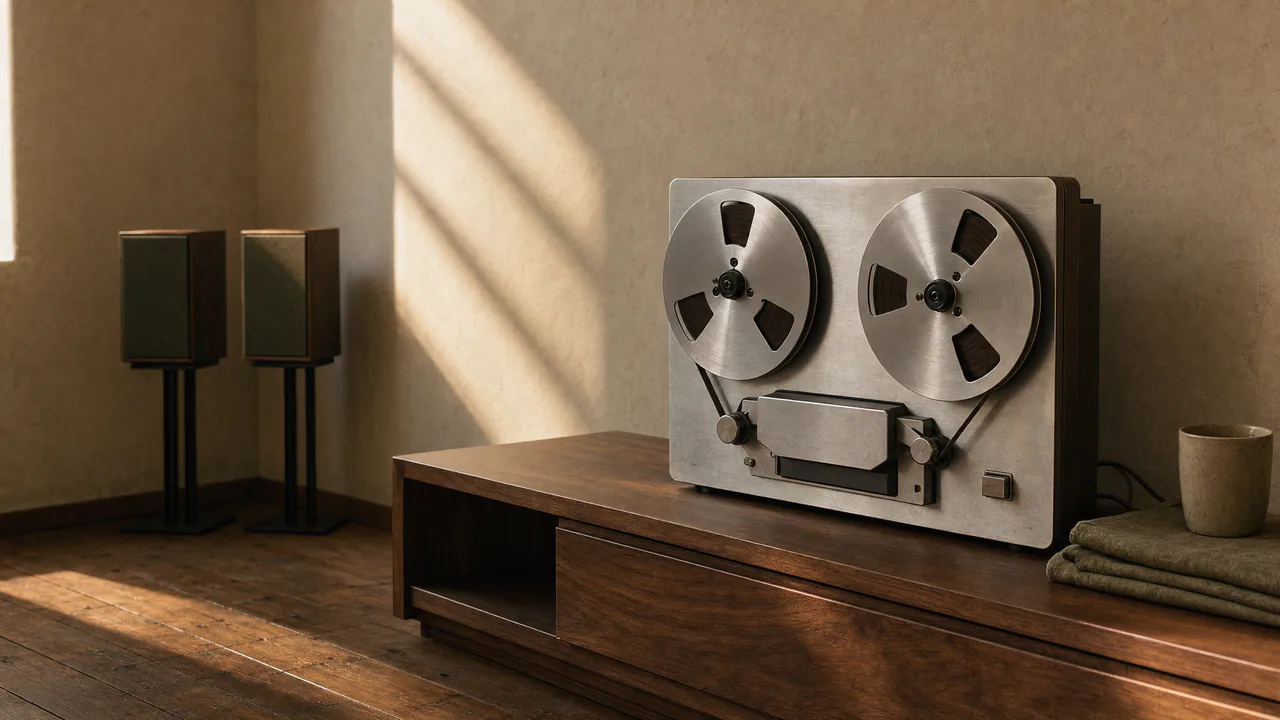
Slowly turning reels
The reels turn less than half a turn a second; at the faster speed one of their dark windows passes any one spot about once a second. The rest of the room stays still. Sound plays only if you start with it.
What you can do here
- Stop and start the tape
- Tap the small square switch at the lower right of the deck, press the space bar, or untick Running. The reels coast to a stop over a few seconds and spin back up when you start them again.
- Change the speed
- Speed switches between 3¾ and 7½ inches a second, the two speeds most home decks used. At 7½ the reels turn twice as fast.
- Follow a reel
- Move over either reel and a thin highlight runs along its rim, following your pointer around the edge.
Use it as your wallpaper
Press F for fullscreen and M to turn the sound off and on; the volume and your sound choice carry over to every wallpaper. The sound keeps playing if you switch to another tab.
Live link
https://whitescreen.tv/interactive-wallpapers/reel-to-reel-tape/#wallpaper- On a computer desktop
- Some wallpaper apps can show a web page behind your desktop icons. Give one the live link above and the scene runs there on its own: no page around it, no ads and no sound.
- On a TV or a spare screen
- Open this page and press F, or use Fullscreen. While it’s in fullscreen we ask the browser to keep the screen from going to sleep.
- On a phone or tablet
- Save image downloads exactly what’s on the screen as a picture. Set it as your wallpaper from your photos; the phone will crop the sides.
A live wallpaper keeps a page running all day. Through the live link the scene draws at most 30 frames a second and stops while the screen is covered, but on a laptop it still costs some battery.
Why the two reels turn at different speeds
On a reel-to-reel deck the tape isn’t pulled by the reels. A spinning capstan pinches it against a rubber roller and draws it past the heads at a steady speed. The reel holding more tape has a bigger circumference, so it needs fewer turns to let out or take up the same length, and it turns more slowly. As a tape plays through, the two reels gradually trade speeds. Here the left reel holds a little more tape, so it turns a little more slowly.
About the sounds
Two recordings and one quiet layer: the transport running, the click of its switch, and the air of a quiet room. No music plays; the sound is the machine itself, and it fades out as the reels coast to a stop.
If you’d rather just watch
Picture and sounds generated from our prompts. Motion, controls and mix by WhiteScreen.tv.
