Sleeping Dragon Cove
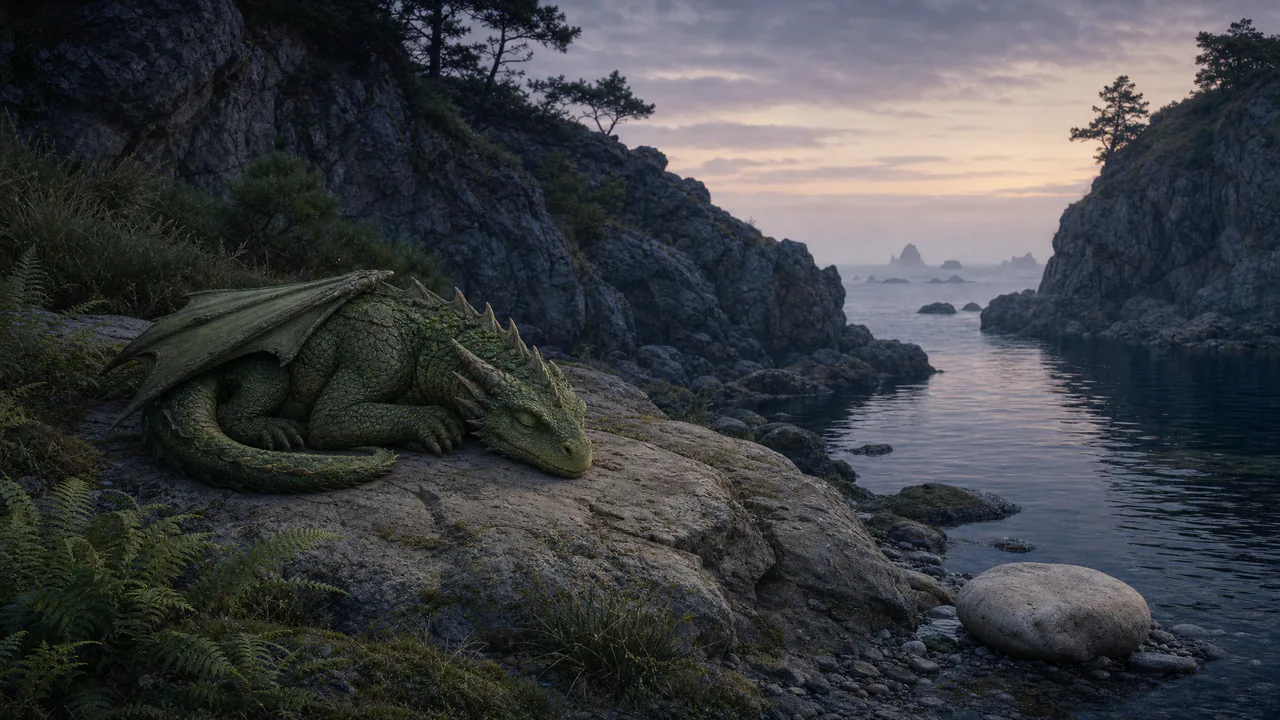
A small dragon asleep on a rock above a quiet cove at dusk. It breathes slowly, the water moves, and it doesn’t wake up.
Slow breathing
The dragon’s back rises and settles about once every ten seconds, and the water in the cove moves a little. Nothing flashes. Sound plays only if you start with it.
What you can do here
- Watch it breathe
- The dragon takes a slow breath about every ten seconds. Its back and folded wing rise a little and settle, its head barely moves, and a faint wisp of breath drifts away from its nose.
- Nudge it
- Tap the dragon, or the pale stone on the shore. It lets out one long sigh and takes a deeper breath, then sleeps on. It won’t sigh again for ten seconds, however often you tap.
- Lean in
- Lean in brings you a little closer to the dragon. Its breathing gets louder and the sea gets quieter.
- Calm or choppy
- Waves sets how much the water in the cove moves.
Use it as your wallpaper
Press F for fullscreen and M to turn the sound off and on; the volume and your sound choice carry over to every wallpaper. The sound keeps playing if you switch to another tab.
Live link
https://whitescreen.tv/interactive-wallpapers/sleeping-dragon-cove/#wallpaper- On a computer desktop
- Some wallpaper apps can show a web page behind your desktop icons. Give one the live link above and the scene runs there on its own: no page around it, no ads and no sound.
- On a TV or a spare screen
- Open this page and press F, or use Fullscreen. While it’s in fullscreen we ask the browser to keep the screen from going to sleep.
- On a phone or tablet
- Save image downloads exactly what’s on the screen as a picture. Set it as your wallpaper from your photos; the phone will crop the sides.
A live wallpaper keeps a page running all day. Through the live link the scene draws at most 30 frames a second and stops while the screen is covered, but on a laptop it still costs some battery.
How the breathing works
The dragon is part of the photograph, so nothing is redrawn. On each breath its body is stretched upward from the line where its belly rests on the rock: a few pixels at the top of its back, less toward its head, which stays almost still. That is roughly how a sleeping animal looks when it breathes. The ribs lift and the head rests.
About the sounds
Three recordings: slow, sleepy breathing, a single long sigh for when you nudge it, and the open air by the water. The breathing you hear and the breathing you see keep the same unhurried pace, but they aren’t locked together, so now and then they drift apart.
If you’d rather just watch
Picture and sounds generated from our prompts. Motion, controls and mix by WhiteScreen.tv.
