Cloud Observatory
A small observatory above the weather: an open dome, a brass telescope, snowy peaks in a sea of cloud, and the first stars. Let the light fade to night.
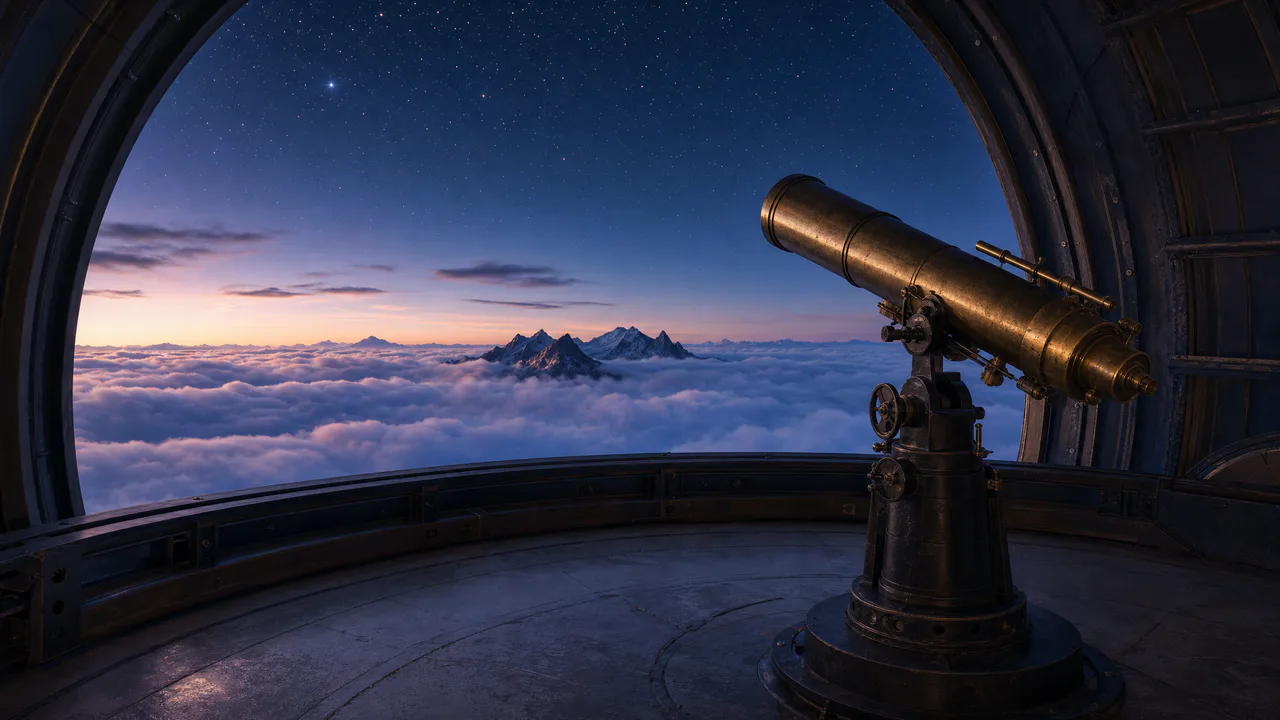
Slow clouds
The clouds roll slowly and the stars twinkle a little. Turning the light toward night takes a few seconds. Nothing flashes. Sound plays only if you start with it.
What you can do here
- Watch the clouds
- The cloud sea drifts and rolls the whole time, slowly, the way a real one moves when you watch it from above for a while. Mountain air makes it a little livelier, and louder.
- Let the night come
- Light takes the sky from last light through the blue hour to night. The warm band at the horizon cools, the clouds turn blue-gray and more stars show. Each step takes a few seconds.
- Look along the telescope
- Move the pointer along the brass tube and a warm glint follows it, then fades when you move away.
- Tap the rail
- Tap the curved rail at the foot of the dome and the structure settles with a low creak while a glint runs along the metal.
Use it as your wallpaper
Press F for fullscreen and M to turn the sound off and on; the volume and your sound choice carry over to every wallpaper. The sound keeps playing if you switch to another tab.
Live link
https://whitescreen.tv/interactive-wallpapers/cloud-observatory/#wallpaper- On a computer desktop
- Some wallpaper apps can show a web page behind your desktop icons. Give one the live link above and the scene runs there on its own: no page around it, no ads and no sound.
- On a TV or a spare screen
- Open this page and press F, or use Fullscreen. While it’s in fullscreen we ask the browser to keep the screen from going to sleep.
- On a phone or tablet
- Save image downloads exactly what’s on the screen as a picture. Set it as your wallpaper from your photos; the phone will crop the sides.
A live wallpaper keeps a page running all day. Through the live link the scene draws at most 30 frames a second and stops while the screen is covered, but on a laptop it still costs some battery.
When you can see a sea of clouds
A cloud sea forms when a layer of low cloud is trapped under warmer air above it, a temperature inversion, and you stand higher than its top. Mountain observatories are often built above that layer for the same reason: the air over it is steadier and drier, which makes for sharper views of the stars.
About the sounds
Two recordings: wide, high mountain air, and the dome settling. There is no music and no motor noise; up there it is mostly the wind.
If you’d rather just watch
Picture and sounds generated from our prompts. Motion, controls and mix by WhiteScreen.tv.
