Aurora Camp
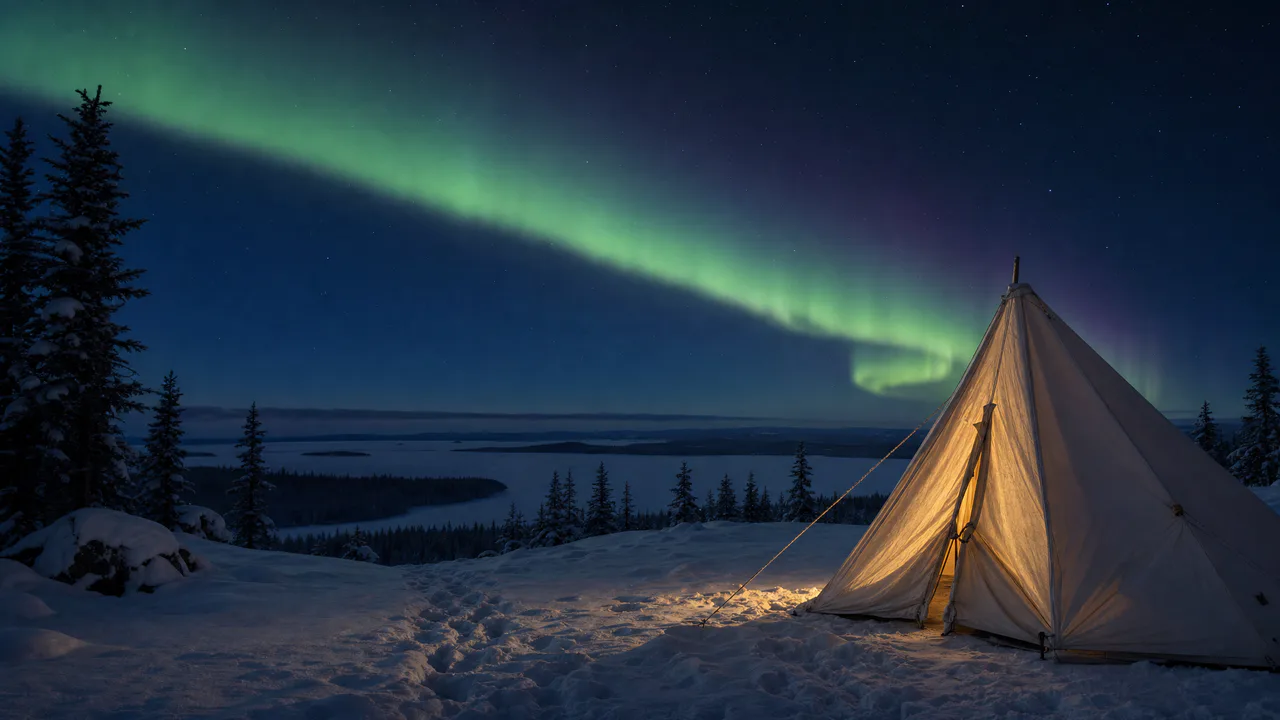
A canvas tent glows on a snowy ridge under a green aurora. Move the light around, raise the activity, dim the lantern, and listen to the wind.
Slow light
The aurora drifts and brightens slowly, and a little snow blows across the ridge. Nothing flashes. Sound plays only if you start with it.
What you can do here
- Move the aurora
- Drag across the sky, or just move the mouse over it. The curtain brightens where you are and leans toward you, over a few seconds rather than at once.
- Turn up the activity
- Activity goes from a quiet green arc to a storm night, when the curtain ripples faster and red and violet show along its edges.
- Dim the lantern
- Turn the lantern down and the tent goes dark, which is how you would really watch an aurora: your eyes need the dark to see it.
- Wind and canvas
- Wind raises the sound of the wind and the snow it carries across the ridge. Tap the tent to hear the canvas lift and settle.
Use it as your wallpaper
Press F for fullscreen and M to turn the sound off and on; the volume and your sound choice carry over to every wallpaper. The sound keeps playing if you switch to another tab.
Live link
https://whitescreen.tv/interactive-wallpapers/aurora-camp/#wallpaper- On a computer desktop
- Some wallpaper apps can show a web page behind your desktop icons. Give one the live link above and the scene runs there on its own: no page around it, no ads and no sound.
- On a TV or a spare screen
- Open this page and press F, or use Fullscreen. While it’s in fullscreen we ask the browser to keep the screen from going to sleep.
- On a phone or tablet
- Save image downloads exactly what’s on the screen as a picture. Set it as your wallpaper from your photos; the phone will crop the sides.
A live wallpaper keeps a page running all day. Through the live link the scene draws at most 30 frames a second and stops while the screen is covered, but on a laptop it still costs some battery.
What the colors mean
Auroras glow when particles from the Sun strike the thin air high above the poles. The common green comes from oxygen atoms roughly 100 to 300 kilometers up. Red is oxygen too, glowing higher still, and it mostly appears in strong storms. Blue and violet come from nitrogen, often along the lower edge of a bright curtain.
Reading an aurora forecast
Forecasts use the Kp index, a 0 to 9 measure of how disturbed Earth’s magnetic field is, issued for every three hours. At Kp 2 or 3 the aurora stays close to the Arctic Circle. Kp 5 is what NOAA calls a minor geomagnetic storm (G1), and the lights reach further south. At Kp 7 and above, a strong storm, they can be seen far from where they usually are. The three Activity steps here stand roughly for Kp 2, 4 and 7.
About the sounds
Two recordings: wind across open snow, and the tent’s canvas lifting and settling. The aurora itself makes no sound here, as it doesn’t for almost everyone who has stood under one.
If you’d rather just watch
Picture and sounds generated from our prompts. Motion, controls and mix by WhiteScreen.tv.
