Lunar Outpost
A small cabin on the Moon, a gray plain outside, and the Earth hanging in a black sky. Lean to look around, and watch the Earth turn.
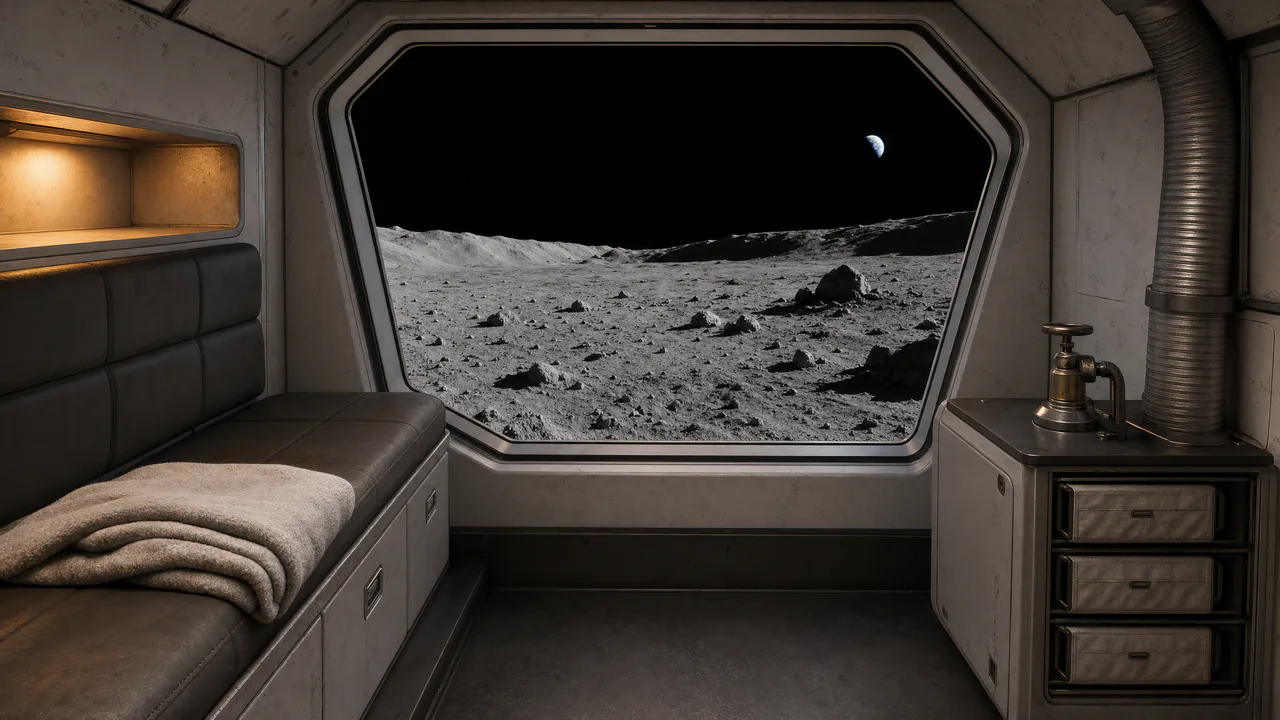
A very still place
Outside, nothing moves on its own. Inside, a little dust drifts in the reading light, and the Earth turns slowly. Nothing flashes. Sound plays only if you start with it.
What you can do here
- Look around the window
- Move the pointer toward an edge of the window, the way you would lean to see past the frame. The plain and the sky shift against the frame; the ground near the glass shifts a little less, because it is closer.
- Watch the Earth turn
- The Earth turns once a day, west to east, while the Sun keeps lighting the same side. At Real time you won’t see it move. At A day a minute clouds and coastlines drift slowly across the lit half; at A day in ten seconds they slide past.
- Dim the cabin
- Cabin light turns the reading light down, and the life-support hum drops with it. It never goes silent: the blowers keep the air moving whatever the light is doing.
- Open the valve
- Tap the brass valve on the cabinet, or press Open the valve, for a soft sigh of air and a warm glint on the brass. It waits eight seconds before it will open again.
Use it as your wallpaper
Press F for fullscreen and M to turn the sound off and on; the volume and your sound choice carry over to every wallpaper. The sound keeps playing if you switch to another tab.
Live link
https://whitescreen.tv/interactive-wallpapers/lunar-outpost/#wallpaper- On a computer desktop
- Some wallpaper apps can show a web page behind your desktop icons. Give one the live link above and the scene runs there on its own: no page around it, no ads and no sound.
- On a TV or a spare screen
- Open this page and press F, or use Fullscreen. While it’s in fullscreen we ask the browser to keep the screen from going to sleep.
- On a phone or tablet
- Save image downloads exactly what’s on the screen as a picture. Set it as your wallpaper from your photos; the phone will crop the sides.
A live wallpaper keeps a page running all day. Through the live link the scene draws at most 30 frames a second and stops while the screen is covered, but on a laptop it still costs some battery.
Why nothing moves outside
The Moon has no air to speak of, so there is no wind to stir the dust, no clouds, no haze, and no twinkling: stars twinkle on Earth only because our air bends their light. In lunar daylight the bright ground outshines all but the brightest stars, which is why the Apollo photographs show a black sky with none in it. The shadows do move, but slowly: a lunar day lasts about 29.5 Earth days, so the Sun crosses the sky at about 12 degrees an Earth day.
Why the Earth stays in one place
The Moon keeps the same face toward the Earth, so from any spot on the near side the Earth hangs in almost the same part of the sky all month, wandering by up to about eight degrees. It doesn’t rise or set. It does turn, once every 23 hours 56 minutes, and it goes through phases, opposite to the Moon’s: when we see a new Moon, the Moon sees a full Earth. From the Moon the Earth looks almost four times wider than the Moon does from here.
About the dust
Even sealed habitats collect dust, and lunar dust is fine, sharp and clingy. In the cabin’s air it drifts with the vents; with a sixth of Earth’s gravity it settles about six times more slowly than it would at home.
About the sounds
Two recordings and one quiet layer: the life-support blower, the soft sigh of the valve, and the hush of a sealed habitat’s air. There is nothing to hear from outside.
If you’d rather just watch
Picture and sounds generated from our prompts. Motion, controls and mix by WhiteScreen.tv.
